


Which ingredients have we banned from our children's toothpaste?
Clay-free (Illite, Kaolinite, Montmorillonite)
Clay is often used in cosmetic products due to its absorbent and purifying properties. However, it has disadvantages when used in formulations for children, particularly in toothpastes.
The ANSM agrees with us
Even the French National Agency for Medicines and Health Products (ANSM) warns us against the use of clay-based products in young children under two years of age. The harmful effects of lead and other heavy metals on children's health are well known, so it is essential to limit their exposure as much as possible.
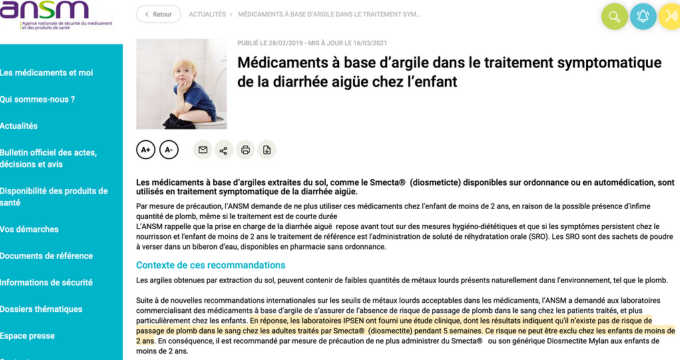
It is probably not necessary to remind you of the harmful effects of heavy metals and lead on children's health.
What are the authorities doing?
Today, European Union regulations prohibit the voluntary addition of lead to cosmetics but traces of heavy metals are allowed if they are unavoidable and present in raw materials. However, the clearly established limits for these traces in regulatory legislation are not fixed.
However, traces of heavy metals are allowed if they are unavoidable (contained in raw materials) and for these traces there are no clearly established limits in regulatory legislation.
Fortunately, the German government is stricter regarding the allowance of heavy metal traces. The limits set by the German government are 2 ppm for care products, 5 ppm for make-up, 0.5 ppm for toothpaste and 0.2 ppm in food. This shows the importance of taking measures to ensure the safety of products intended for children.
Why is clay dangerous for children?
Children, due to their increased vulnerability, are more susceptible to being affected by lead and other heavy metals. To ensure their safety, some of our toxicologist friends recommend an even more cautious approach, using a safety margin of 50 or even 100. This means that they multiply the recommended safety limit by 50 or 100 to take additional precautions. For example, when it comes to children's toothpaste, the lead content should not exceed 0.01 ppm, which is extremely low to minimize potential risks.
However, the heavy metal content in clays is highly variable. For example, see below a study on Nigerian clays:
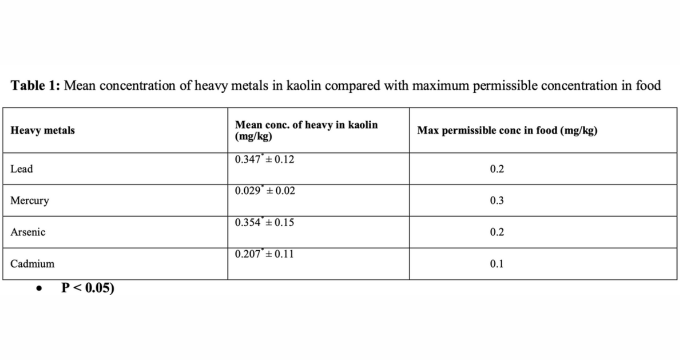
Not to mention the dose of Arsenic and Cadmium, which are fortunately subject to regulatory food limits.
To summarize:
The lead content in kaolin (white clay) is 0.347 ppm. According to our calculation, to ensure the safety of a children's toothpaste containing kaolin, no more than 3% can be added.
Knowing that heavy metals accumulate in the body with repeated exposure, would you want to take the risk?
Clay is widely considered a problematic ingredient when it comes to formulating products. But not only because of the presence of heavy metals; due to its porous structure, it also harbors a lot of microbes... Once in contact with water, or even just humidity, the quantity of microbes contained in the product is not at all controlled.
Unfortunately, with the growing popularity of DIY cosmetics, clay is being used more and more frequently, especially in oral care products.
In summary, due to the potential risks linked to heavy metal content such as lead, clays are considered a problematic ingredient in the formulation of oral care products for children. It is important to take these risks into account and opt for safer alternatives adapted to children's needs.
Without calcium bicarbonate
We've seen many brands claim to use grandmother's remedies and homemade products. These remedies can indeed be excellent natural remedies when there is no other choice.
Did you know that the most abundant mineral on Earth is calcium? It is found in chalk, limestone...
However, in children's toothpaste, we won't use it for two reasons.
Abrasiveness is not controllable
Indeed, baking soda is a salt; with humidity, it tends to clump together and thus increase the size of the "grains" contained in the toothpaste. This increases the particle size and therefore the abrasiveness of the toothpaste over time. In the long term, this can prove dangerous for the enamel of small teeth.
Be careful not to swallow too much calcium
In case of repeated overdose, it presents a risk for very young children: "milk-alkali syndrome".
Milk-alkali syndrome is characterized by the triad:
- hypercalcemia
- metabolic alkalosis
- kidney failure
This syndrome occurs after starting a milk and alkali diet, or after prolonged consumption of calcium carbonate (4 to 5 grams/day) or less if other factors are present.
A toothpaste rich in calcium bicarbonate is not at all recommended for young children who also drink a lot of milk.

Pentylene Glycol-free
With the trend of natural and clean beauty cosmetics, this family of molecules has been mainly used for its antimicrobial power, as a 100% natural preservative. Moisturizing, antimicrobial, it seems to be the perfect family of molecules, but we'll explain why we don't use them.
A little harsh for oral mucous membranes:
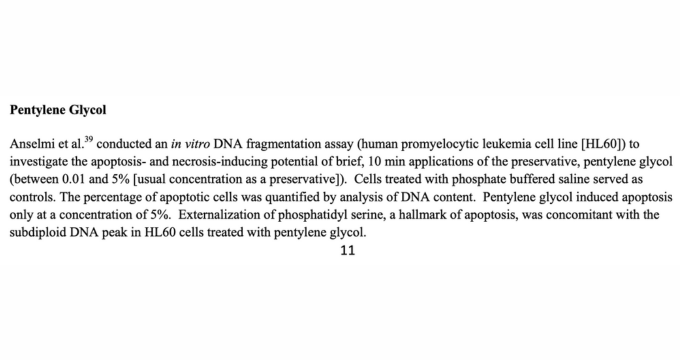
Compared to other conventional preservatives, pentylene glycol's antimicrobial power is weak. Indeed, it must be used at a concentration between 3 and 5% to be effective, which poses a problem for us...
For example, at 5%, pentylene glycol has an anti-cancer action *in vitro*. This means that cancer cells cannot tolerate this ingredient at 5%, which is nevertheless used as an effective preservative. We'll let you imagine the consequences of its use in a young child's mouth...
It stings
We've already tasted pentylene glycol in the lab; it stings the tongue. Irritation tests on the gingival epithelium (gums) are not optimal.
Obviously, using it in an oral care product seems to us to be an uncontrolled risk of canker sores or even oral ulcers for small mouths.
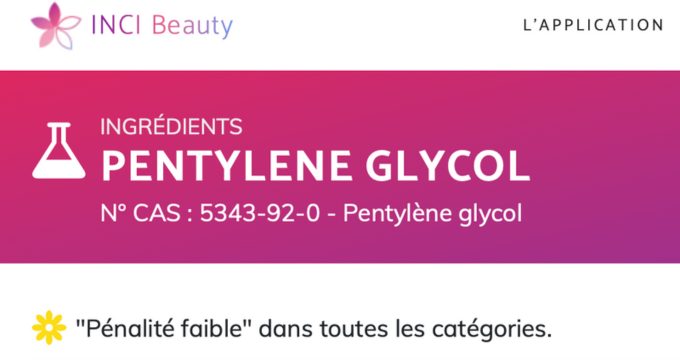
Hats off to INCI beauty, which classifies pentylene glycol as yellow "low penalty."
No sodium benzoate
Well, you're starting to know our opinion on sodium benzoate
However, we will not stop our fight against the abusive use of sodium benzoate in organic children's products.
Indeed, there is growing evidence linking hyperactivity and attention disorders with young children's exposure to sodium benzoate.
Nevertheless, we will specify the characteristics of sodium benzoate that make it unusable in toothpaste in our opinion.
Be aware that this preservative is effective in an acidic pH environment, where sodium benzoate transforms into benzoic acid.
However, acidity and tooth enamel do not mix well over time, which is why (in addition to all its other drawbacks) we prefer to avoid it.
Dye-free
Without even talking about the "whiter than white" color obtained with titanium dioxide in toothpastes (a real crime in our eyes, especially when intended for children). Moreover, it is still not banned in the EU, which is incomprehensible.
There are also other colorants, such as iron oxide for the pink color. However, iron oxide is derived from minerals, so it has similar flaws to clay: a risk of heavy metal exposure, "just" for a color...
Furthermore, when a child begins to learn to brush their teeth with pink or red toothpaste, they may feel a little destabilized later when they have to use a "grown-up" toothpaste that is not colored (or that may be whitened...).
Really unnecessary in our opinion.
Stevia Rebaudiana Extract-Free
Stevia rebaudiana extract was approved by the European Union as a sweetener from 2011 onwards.
Indeed, the sweetening power of this sweetener is around 300. For comparison, polyols, sorbitol, xylitol, etc., have a sweetening power between 0.5 - 1, and the famous aspartame has a sweetening power of 200.
This naturally derived sweetener is suitable for diabetics, those wishing to lose weight, and is non-cariogenic.
Even the great Coca-Cola uses it for its natural and dietary image by incorporating it into its "Life" Coca-Cola.
Stevia in toothpastes?
Yes, we have noticed that Stevia rebaudiana extract is often used in children's dental care to add a touch of naturalness to the formula.
However, this extract mainly contains Rebaudioside A, a terpenoid also called "Steviol Glycoside."
So what, you ask? This worries us, because the structure of this molecule is very similar to that of sex hormones, look at this image:

Have you noticed this "tricycle" shape (highlighted in orange)?
It is possible that our body's hormonal receptors react to this substance, which would imply a phytoestrogenic effect of stevia extract on children's bodies. Because, indeed, their small bodies are much more sensitive to hormones than an adult's...
Is this effect proven?
Obviously, as with any information we convey, we did our research to be sure. We found 3 articles (dating from 1968, 1999, and 2016) on *in vivo* and *in vitro* studies of the endocrine potential of this molecule in mammals.
First article:
- 1968 studies ****Mazzei-Planas G, Kuc J. Contraceptive properties of Stevia rebaudiana. Science. 1968;162(3857):1007.
Result:
Stevia decoction has a contraceptive effect in female mice. They were administered 10 ml of 5% concentrated stevia extract per day. At the end of the study, this effect persisted for another 50 to 60 days. (see image below)
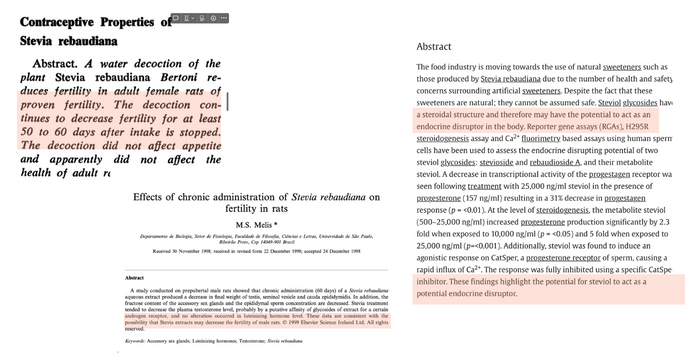
Second article:
- 1999 study, Melis MS. Effects of chronic administration of Stevia rebaudiana on fertility in rats. J Ethnopharmacol. 1999;67:157–61.
Result:
For 60 days, male rats received a dose of stevia decoction, and at the end of this period, a decrease in testosterone levels, sperm concentration, and the definition of sex glands were observed.
Third and final article:
. 2016 studies Maeeve Shanon et al. In vitro bioassay investigations of the endocrine disrupting potential of steviol glycosides and their metabolite steviol, components of the natural sweetener Stevia. Molecular and cellular Endocrinology Volume 427, 15 May 2016, Pages 65-72
This study was not performed on animals, but *in vitro*, on hormone receptor proteins. The results once again demonstrate a potential effect on endocrine receptors.
Why is stevia still used?
Despite the fact that health authorities consider that the dose of 4mg/kg per day should not be exceeded, no particular precautions need to be taken.
However, toxicological studies are evolving; we all remember the aspartame scandal.(WHO article)
Not to mention the power of lobbying, it's a valuable ingredient with a sweetening power far superior to other existing ingredients, making it a very economical ingredient.
For all these reasons and risks, we have blacklisted Stevia extract for our children's oral care products.
To replace it, we use polyols, which have a very simple and non-active chemical structure. Although they are much more expensive (because they are 300 times less sweet), we prefer not to take any risks to respect children's small bodies.
Unfortunately, some naturopaths promote products containing stevia extract, even though polyols are much safer to use.
How did we formulate our children's toothpaste?
As you know, we've put a lot of work into this 100% natural children's toothpaste to offer you the best for their oral hygiene.
We'll detail all the ingredients (and their roles) in a future article, so stay tuned!
If you have any questions, comments or opinions, please feel free to write to us at coucou@lilikiwi.fr or by DM on our social networks!