


Fluoride is a substance that causes a lot of debate in children's toothpaste (and not only there). Especially since the advent of the organic trend, many brands demonize fluoride to better sell fluoride-free toothpastes. To the point that parents are often lost in the face of so many contradictory statements. How can we be sure we are doing what is necessary to properly protect our children's teeth and oral health? In reality, fluoride-free toothpastes are not a very good idea for oral health, especially for children's oral health. Why do we need fluoride in toothpaste? Should children's toothpaste contain fluoride? In this article, we will answer your questions and explain our choices.
What is fluoride?
In reality, when we talk about fluoride, we are generally referring to fluoride salts or oligofluorides, and not the element fluorine itself. Indeed, pure fluorine is extremely reactive and explosive, just like its cousin chlorine (belonging to the same family of elements in the periodic table, the halogen family).
Halogens, but not the lamp!
The elements in this family are toxic and explosive in their isolated form. It was a French, even Parisian, chemist, Henri Moissan, who first succeeded in isolating fluorine and won the Nobel Prize in Chemistry in 1906. Before him, many scientists lost their lives trying to isolate fluorine.

Not very reassuring...
Well, let's get back to children's toothpaste, or rather, not right away, a little more history first!
As early as 1938, there were already doubts about its beneficial effects on teeth, but in salt form, it became super stable. Like chloride in the form of 'table salt,' called sodium chloride, it is very stable, the same applies to sodium fluoride often used in fluoridated toothpastes.
And yes, nobody wants toothpaste that explodes in their bathroom...
How was fluoride toothpaste created?
Okay, we're back to our topic of children's toothpaste, oh no, not yet, a little more history! (Yes, again, but you'll see, the history of fluoride is interesting)
As early as 1938, studies were conducted on the effects of sodium fluoride on cavities. Then, it wasn't until 1947 that dental caries prophylaxis was enhanced with a new fluoride therapy.
Indeed, Frédéric Piquet added the method of local applications of fluoride varnishes to prevention techniques.
The first report on a clinically effective fluoride toothpaste was written in 1954 (Muhler et al).
This product combines a stannous fluoride with an abrasive system based on calcium pyrophosphate. This toothpaste gained worldwide recognition for its preventive efficacy.
From then on, fluoride toothpaste entered our lives!
What is fluoride for in toothpaste?
Its main benefit, as we have seen, is the prevention of cavities due to its topical effect (1).
Tooth decay occurs when plaque, a sticky film of bacteria on the tooth surface, feeds on sugar and food debris to produce acid, which dissolves the tooth surface (this is demineralization).
First of all, decay is an infectious disease of the teeth: the danger could become very significant in extreme conditions: cardiovascular problems, etc...
For now, the best way to prevent them is to introduce topical fluoride.
The three main preventive actions of topical fluoride
- It inhibits plaque. Fluoride can kill or inhibit bacteria and make them less able to produce acids from carbohydrates.
- It inhibits demineralization. Fluoride is integrated into crystals on the tooth surface, which makes this surface more resistant to acid.
- It promotes enamel remineralization. The process of enamel demineralization and remineralization is constant. Fluoride increases the speed of the process, and the incorporation of fluoride into the mineral makes it less soluble to acid.
There are many studies on the effectiveness of plant extracts and xylitol, but the results are not always very conclusive.
However, the combination of sodium fluoride and xylitol in a toothpaste proves more effective than fluoride alone in dentin remineralization (2).

What about the famous fluorosis then?
What is fluorosis?
It is an excess of fluoride resulting in stains on the teeth, it often occurs during childhood and unfortunately has no treatment. So these stains remain for life.
In reality, fluorosis only occurs in cases of real overdose, of overexposure to fluoride. Rest assured, the consumption dose in cosmetics is regulated and presents an extremely low risk of possible fluorosis.
Fluoride, as much as you want...
In the 1960s, scientists made a big shift by proposing to give fluoride tablets to children to prevent cavities.
The problem is that with this somewhat extreme method, some people suffer from overexposure to fluoride which can induce the famous fluorosis.
Nowadays, we have calmed down on fluoride tablets, but some brands offer fluoride-free toothpastes and use this story for marketing purposes.
What about fluoride in children's toothpaste?
Finding a balance
Now, you probably understand that the real problem with fluoride in toothpastes is to respect the right dose. Too little fluoride: risk of cavities, too much fluoride: risk of fluorosis...
For this reason, the UFSBD regularly updates its recommendations so that we know the "right dose" for our children.
What the UFSBD says:
The French Union for Oral Health (UFSBD) is the dental profession's organization whose purpose is to stimulate, animate, and coordinate all efforts undertaken in favor of oral health in France.
Therefore, it is a reference that has a lot of information on clinical cases and the general state of oral health (see the spreadsheet).
That's why we follow their recommendations to formulate our 100% natural toothpaste for children.
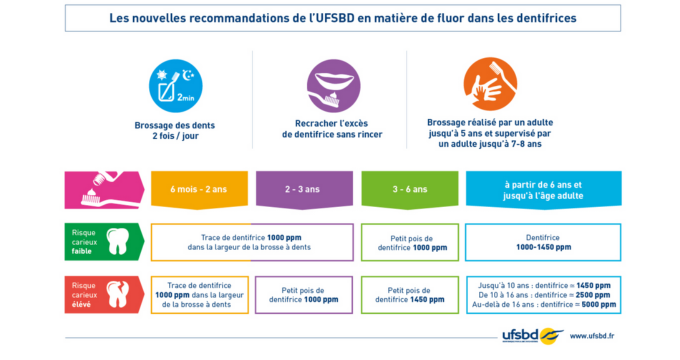
What does ppm mean?
PPM = Parts Per Million, it is a unit of concentration to express ultra-low dosages. It can be translated into mg/Kg or as a percentage; 1 ppm is equivalent to 0.0001% (so very little).
For example, in food: the permitted amount of lead is 0.2 ppm, which means less than 0.00002%.
And in children's toothpaste?
For children at low risk of cavities, the UFSBD only proposes 2 dosages for children from 6 months: 1000 ppm and 1450 ppm.
However, they vary the recommended quantity to ensure that the actual dose (concentration x quantity) is lower.
How much toothpaste should be used per brushing?
Indeed, the UFSBD provides recommendations for dosage, but also for the amount of toothpaste to use daily according to your child's age.
In these recommendations, quantities are measured in "trace" or "pea-sized" to replace a precise dose like 0.25 g.

Do you see what we're getting at?
Following your many requests for a healthy, 100% natural toothpaste for children, we have created these products:
First, a toothpaste with 1000 ppm of fluoride for children aged 3 to 6 years. We are still working on a toothpaste dosed at 1450 ppm for children over 6 years old (or younger children who have received this recommendation from their dentist or doctor).
While we have followed the UFSBD recommendations to the letter for these two products, we have also created a product with 500 ppm.
Indeed, for children under 3 years old, we chose to offer a lower-dosed toothpaste, and we will explain all this in a future article.
The fluoride assessment
The benefits of fluoride for dental health are undeniable, but in case of overdose, various problems can arise.
The safest way to fully benefit from fluoride's cavity-preventing effects and avoid overdose is to have a fluoride assessment with your dentist.
In fact, for professionals, there is a recommended daily fluoride intake based on age and weight.

Regarding the fluoride intake from our brand's toothpaste, we take extreme precautions and a safety margin (we consider the worst-case scenario) by assuming that the toothpaste is completely ingested, compared to the table above where the calculation was based on an ingestion of 40% of the toothpaste used.
How to calculate your fluoride balance?
For the balance with your dentist, you can provide these figures:
For 500 ppm toothpaste (500 mg/kg) - trace size (0.125 g)
500 mg/kg X 2 times/day X 0.125 g/1000 = 0.125 mg/day
For 500 ppm toothpaste (500 mg/kg) - pea size (0.25 g)
500 mg/kg X 2 times/day X 0.25 g/1000 = 0.30 mg/day
And for 1000 ppm toothpaste (1000 mg/kg) - pea size (0.25 g)
1000 mg/kg X 2 times/day X 0.25/1000 = 0.50 mg/day
A small example:
If your 9 kg child cannot yet spit properly, and consumes 1 L of Vichy Saint-Yorre water (fluoride content of 8.2 mg/kg) per day, their fluoride intake is
8.2 kg/9 kg = 0.91 mg/day/weight, which is a bit high, as the recommended dose is 0.75 mg/day/weight.
In this case, it is reasonable to reduce the dose of fluoride in the toothpaste or change the water to limit this intake.

the spreadsheet is a screenshot we found on this site which also provides the amount of fluoride in mineral waters and in food.
If you have any questions, please feel free to write to us at coucou@lilikiwi.fr or via DM on our networks, we will be happy to answer you.
Sources :
(1) Shellis RP, Duckworth RM. Studies on the cariostatic mechanisms of fluoride. Int Dent J. 1994 ; 44(Suppl l) : 263–73.
(2) Grimaud et al. Les polyols en odontologie pédiatrique : intérêt du xylitol. The polyols in pediatric dentistry : advantages of xylitol. Archives de Pédiatrie Volume 12, Issue 7, July 2005, Pages 1180-1186.
(3) THE EFFECT OF A STANNOUS FLUORIDE-CONTAINING DENTIFRICE ON CARIES REDUCTION IN CHILDREN JOSEPH C. MUHLER, ARTHUR W. RADIKE, WILLIAM H. NEBERGALL AND HARRY G.DAY School of Dentistry and Department of Chemistry, Indiana University, Bloomington, Indiana, and College of Dentistry, Ohio State University, Columbhs, Ohio