


What is a surfactant?
Explanations...
In life, we always say, "birds of a feather flock together." It's the same in the world of chemistry; you need 'fat' to dissolve 'fat.'
Indeed, oils are excellent when it comes to dissolving and removing dirt and grease from our skin and hair.
However, the problem is that oil is not water-soluble, making it difficult to rinse off. Especially for your hair, imagine washing your hair with oil!
We all want our freshly washed hair to be silky, light, and non-greasy. To solve this problem, all skin and hair cleansing products such as shampoo, shower gel, and soap are formulated with cleansing compounds called surfactants (SAs).
How does it work?
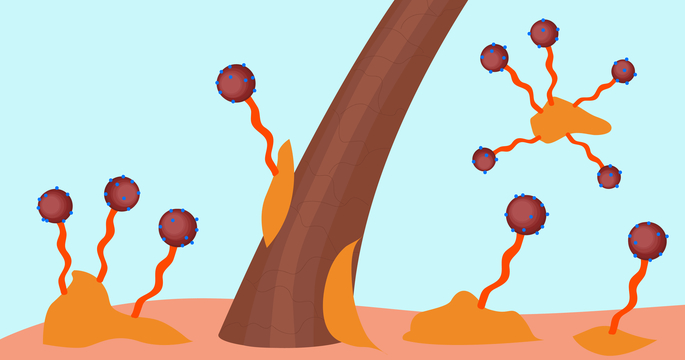
In terms of chemical structure, SAs resemble a matchstick. They have a head that likes water and a tail that likes fat.
When you wash your hands with a product containing a surfactant, the fat-loving tail of the SA 'enters' the grease and dirt. Then, when you rinse with water, the water-loving heads gather together and form a protective wall around the tails, preventing contact with water.
Together, they form small balls, and the dissolved grease is trapped in the middle. These balls then rinse off easily with water, and the hands are clean.
The surfactant family:
Almost all cleaning products contain SAs to remove grease and dirt.
SAs dissolve all fats, but there are also good fats on the surface of our skin.
Indeed, they are there to protect us, so we shouldn't remove all of them.
Some groups within the SA family are very stripping and can cause dryness and skin irritation.
For a chemist, the SA family is divided into 4 groups based on their charge in their chemical structure: anionic, cationic, amphoteric, and non-ionic SAs.
Lost you? Let's simplify; we can classify SAs simply as solid and liquid.
Solid surfactants
Solid products are in vogue.
Because they are in solid form, they require less packaging.
Therefore, brands can easily claim values such as 'plastic-free' or 'zero waste.'
However, solid products generally contain an aggressive and ill-reputed family of SAs:
Soaps:
"True soaps" such as Marseille soap or solid Aleppo soap are 100% natural. They are obtained through a green chemical reaction resulting from saponification between vegetable oils and a very strong alkaline agent (soda for solid soaps and potash for liquid soaps).
The vegetable oils most often used in France are olive oil for Marseille soap and laurel oil for Aleppo soap.
Indeed, soaps are very strong detergents, particularly perfect for household cleaning.
Nevertheless, they are not suitable for hand and body hygiene for our little ones. As early as the 1960s, scientists revealed that soap was not an ideal product for washing our children.
Indeed, frequent use of soap can cause dermatitis, redness, and itching, not only due to the aggressive SAs they contain but also due to the pH of natural soaps.
Did you know that skin does not have a neutral pH?
Indeed, it is slightly acidic (pH of 5); this acid mantle maintains the skin's balance.
As a result, it provides a favorable environment for good microbes and prevents bad microbes from settling and spreading on our skin. Natural soaps are very alkaline (pH between 8 and 10) and can disrupt the skin's balance.
This can lead to many discomforts and skin pathologies such as psoriasis, Verneuil's disease, and/or atopic dermatitis (skin pH article).
Sulfates:
Now the most harmful group of SAs.
Indeed, as of this year, more than 17k scientific studies have shown their adverse effects. The organic cosmetics group plans to ban them in the new version of the Cosmos V4 Standard (organic label).
We have written an article to explain why to avoid products containing sulfates for our children.
SCI
The famous sodium cocoyl isethionate (SCI) can be found in almost all solid shampoos. It is sulfate-free, inexpensive, and offers good scalp tolerance. Moreover, it rinses very well and leaves hair silky.
So far, this ingredient seems very good. However, it is not authorized in organic reference by certification bodies such as ECOCERT, but why?
The problem with SCI is its manufacturing process.
Derived from heavy chemistry, it is obtained after several reactions, one of which uses ethylene oxide, an extremely reactive, flammable, and harmful gas. You have probably heard of it during the scandal of contaminated sesame imported from India to France.
Ethylene oxide is, on the one hand, polluting for the planet, but also classified as toxic by inhalation and carcinogenic. It therefore involves a significant risk for personnel during manufacturing, but it is also potentially toxic to aquatic organisms if released into nature.
Also note that to manufacture solid shampoos, a significantly higher concentration of SAs is required than for liquid shampoos. Solid shampoos can therefore contain up to 75% SCI. Thus, questioning its manufacturing process is not trivial!
A solid shampoo that is sold with a beautiful image of the sea or forest that makes you dream? Wake up, it would be more of a nightmare!
The good students of solid SA: glutamates
There is an exception in this family of solid SAs: Sodium Cocoyl Glutamates, Sodium Lauroyl Glutamates derived from vegetable oils and amino acids. Super gentle, 100% natural and biodegradable, semi-synthesized from ultra-gentle amino acids for body and hair.
The only downside: it doesn't lather well and is ultra-expensive compared to other SAs. It requires investing about 20 times more compared to a cleansing product containing sulfates.
Liquid surfactants
Glucosides
The APG family, coco glucosides, decyl glucosides.
100% natural, they lather well and are 100% biodegradable!
They are expensive, but a little less so than glutamates.
The bad student of liquid SA: betaines
Betaines are derived from synthetic grafts. That is to say: part of this molecule comes from petrochemicals, the other part is of natural origin.
This family of molecules is allowed in organic cosmetics. The problem with betaines is that they have a strong sensitizing potential.
Especially cocamidopropyl betaines, the most commonly used, there are too many reported cases of allergies.
Advice: how to choose the right SA for my child?
Children's skin is ultra delicate and fragile and has its own peculiarity (article, the skin barrier of children).
Don't be fooled by trends. Their skin must be protected. Let's choose liquid cleansing products that contain the right SAs.
In summary, avoid products that list 'sulfate', 'isethionate', and 'betaine' in the ingredients (INCI list) for your children.
Prefer a product containing only ingredients ending in 'glutamate' and 'glucoside.'
If you have any questions, please do not hesitate to contact us, and we will be happy to discuss with you and advise you.