


First of all, "zero waste" doesn't exist.
Yes, sorry to spoil the fairy tale in the very first paragraph...
The "zero waste" claim is a marketing manipulation, you could call it greenwashing. Just because a product doesn't have plastic packaging doesn't mean it's "zero waste."
So, indeed, at the end of the chain, when you buy your soap by the cut, your shampoo in bulk: no visible waste...
But that soap had to be produced, right?
And alas, the entire production chain, from raw materials to transportation to your store, inevitably generates waste...
The DGCCRF (French Directorate General for Competition, Consumer Affairs and Fraud Control) already prohibits the "zero carbon" claim; we hope they will also soon prohibit the "zero waste" claim...
In reality, what are solid cleansing products?
So, let's introduce them. For a solid cleansing product, there are two solutions:
Soap
As old as time
The production of Aleppo soap is said to be a skill dating back over 2000 years!
The first known trace of our French version of the famous Marseille soap dates back to 1371, attributed to a certain Crescas Davin.
To tell you the truth, Marseille soap is made from vegetable oils, which are saponified through cooking in a cauldron, without adding preservatives or chemicals. (To give you the short version ;))
So yes, soap is a product of natural origin, and it's excellent for household maintenance.
No soap for our children?
But it's not the ideal product for children's hygiene. As early as the 1960s, scientists concluded that soap posed quite a few problems for washing children.
Due to two main reasons:
1. The anionic surfactants from saponification are very harsh on children's skin. "Superfatted soaps" contain more glycerin precisely to mask the harsh effects.
2. Their very alkaline pH (over 8), whereas children's skin is around 5.5. They therefore disrupt the acid mantle that protects our little ones' skin.
Because of these problems, scientists now propose milder, pH-neutral products for the skin, in liquid or solid form.
Dermatological bar
What is it?
The solid version of this "soft soap" is also called a dermatological bar.
In reality, most solid products sold are dermatological bars.
They are solid, so no packaging, with a skin-neutral pH: that's great, Jean-Mi, stop looking, we have the perfect solution!
Well, yes, but no.
It turns out that this dermatological bar also has some significant drawbacks:
Mainly, its problem is that it's solid. Yes, Jean-Mi, we know that when it's solid, there's no packaging and we feel like it's good for the planet, we'll explain:
For a product to be solid, the surfactant (the cleaning agent) must be in solid form.
So far so good.
However, this is an issue for children's skin, but also for the planet.
For a surfactant to be in solid form, it must be in the form of a salt. Most of the time, on ingredient lists, they are called "sodium" something or other.
There could be 3 possibilities:
1. Sulfate salts, the most commonly used. They are even found in organic products. We'll spare you the repetition of their harmful effects: here's the article.
2. SCI (sodium cocoyl isethionate). We think that buying solid products makes the planet happy, but think again! The manufacturing process of SCI is ultra-polluting and energy-intensive. It is also potentially toxic to aquatic organisms. Don't be fooled by the beautiful images on the packaging; you are not saving the oceans: it's a nightmare for little fish...
3. Sodium cocoyl glutamate is a surfactant that is 100% natural and biodegradable. Jean-Mi shouts victory, but alas, we will have to disappoint him again... This product has a very floury, very sticky texture compared to others. Consequently, it requires a lot of texturizers to make it solid (and keep it that way). And you can see where we're going with this: texturizers are fatty alcohols, often obtained from palm oil, which travel three times around the world before reaching the laboratory where your pretty dermatological bar will be fashioned. Another disappointment for your "zero waste" dream. Moreover, due to the pandemic, Indonesia is refusing to export palm oil: good news for orangutans, bad news for "solids."

Anecdote:
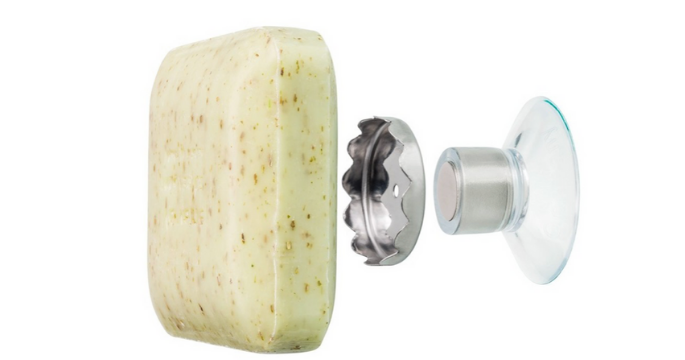
We've also seen some brands offer super PVC suction cup soap holders...
Another false good idea: very complicated recycling due to the combined materials, and the manufacturing process inevitably involves VOCs (Volatile Organic Compounds).
So, it's dangerous for health and the environment. These are often brands that claim to be committed and advocate for planetary protection, but alas, their products only sell you the "impression" of protecting the planet...
Dissolvable products
The new star of cosmetic products (and I'm sure Jean-Mi was about to tell us about them) are dissolvable products.
The idea seems good at first: less transport, therefore fewer carbon emissions, since we're not carrying water "for nothing."
However, from a scientific point of view, this idea seems rather dangerous for our children's health, and this is why.
Preservation
Water is life, and life isn't always ideal in shower gel (hello bacteria), so preservatives must be added to these pretty dissolving tablets.
Often we find our favorite combo: Sodium Benzoate and Potassium Sorbate. We won't repeat the spiel about the risks of this infernal duo in case of overdose: here's the article.
Moreover, another problem, yes Jean-Mi, another problem...
When you add water to your powder, with an acidic pH, sodium benzoate will transform into benzoic acid. This benzoic acid dissolves very poorly in water.
In the lab, powerful ultra-speeds are used, but at home, will Jean-Mi be able to reach 3,000 revolutions/minute? His arm will hurt.
However, if the benzoic acid is not properly dissolved, the preservation will not be optimal.
We'll be honest: after testing and following microbiological studies of certain dissolvable products, we didn't keep them...
Precipitation of surfactants
In tap water, there are many calcium ions. You know, the white marks in your kettle or on glasses after too much dishwasher use?
That reminds me: Jean-Mi, have you descaled the coffee maker?
Anyway, by using your tap water, the surfactant salts contained in your tablet will exchange with the calcium ions. And bam! That makes calcium salts, and so the product becomes insoluble in water.
However, the principle of surfactants is to disappear from our skin with rinsing water, but in this specific case, calcium salts will remain stuck to the surface of your skin...
A little hope for powdered or solid products
The future seems promising for powdered products based on glutamate.
However, it is essential that this product remains dry, unless it turns into a bacteria hostel...
Nevertheless, it represents an ideal solution for an adult facial cleanser, with a well-sealed bottle.
For questions, comments, or just to say hello, our team awaits you at coucou@lilikiwi.fr